AQCat predicts how molecules adsorb onto catalyst surfaces with DFT-grade accuracy in seconds, and it does this for the magnetic, earth-abundant metals that leading catalyst models get wrong. It is a machine learning interatomic potential trained on 13.5 million quantum chemistry calculations across 47,000 catalyst systems. Because it explicitly models spin polarization for iron, nickel, and cobalt, it reaches chemistry that spin-unpolarized models miss, and it holds accuracy parity everywhere else. It runs up to 20,000 times faster than the density functional theory (DFT) simulations teams rely on today, which changes the economics of catalyst screening. The model runs on demand through Claude, and the AQCat25 dataset behind it is available for non-commercial use.
Adsorption sits at the front of catalyst discovery. How strongly a molecule binds to a surface, and in which geometry, sets whether a catalyst performs, so teams need to rank many candidate surfaces before they invest in the expensive steps downstream. Conventional laboratory methods evaluate fewer than 100 candidates per week. DFT simulates the same step rigorously, but it runs slowly and demands heavy compute, which caps how much chemistry a team can explore.
AQCat turns that first pass into fast, inexpensive triage. It runs an automated dense-adsorption workflow end to end: it selects the bulk material, generates the slab, places the adsorbate across many candidate sites, optimizes the geometry, and returns the lowest-energy structure with its binding energy. Running up to 20,000 times faster than DFT, it lets a team rank vast candidate libraries computationally and reserve costly laboratory and supercomputing work for the strongest leads. The value is the cost and time it strips out of early screening, especially for magnetic materials that used to sit behind expensive DFT. Instead of choosing between a slow, rigorous simulation and a fast, approximate guess, teams get both throughput and near-DFT accuracy on the ground-state step that decides everything downstream.
AQCat runs on AQCat25-EV2, a 31-million-parameter machine learning interatomic potential that extends the EquiformerV2 architecture to spin-polarized systems. Spin polarization governs the electronic structure of the first-row transition metals iron, cobalt, and nickel, the metals central to ammonia synthesis and Fischer-Tropsch. Spin-polarized calculations cost far more compute, so the large public datasets that train catalyst models tend to skip them, which leaves spin-unpolarized models wrong exactly where this industrially important chemistry lives. That is why so much of it has stayed out of reach.
Teaching a model magnetism without breaking what it already knows is the hard part. Fine-tuning an OC20-pretrained model on the new magnetic data alone triggers catastrophic forgetting and degrades OC20 accuracy. SandboxAQ trained AQCat25-EV2 from scratch instead, jointly on AQCat25 plus 20 million OC20 examples. The joint model posts a 290 meV energy MAE on OC20 validation, matching the 301 meV baseline it replaces, while cutting AQCat25 test error from 1268 meV to 349 meV. Because the training set mixes two DFT fidelities and two physics treatments, Feature-wise Linear Modulation (FiLM) conditions the network on spin polarization and calculation fidelity so it knows which regime each system belongs to. FiLM variants consistently outperform their non-FiLM counterparts on spin-polarized systems.
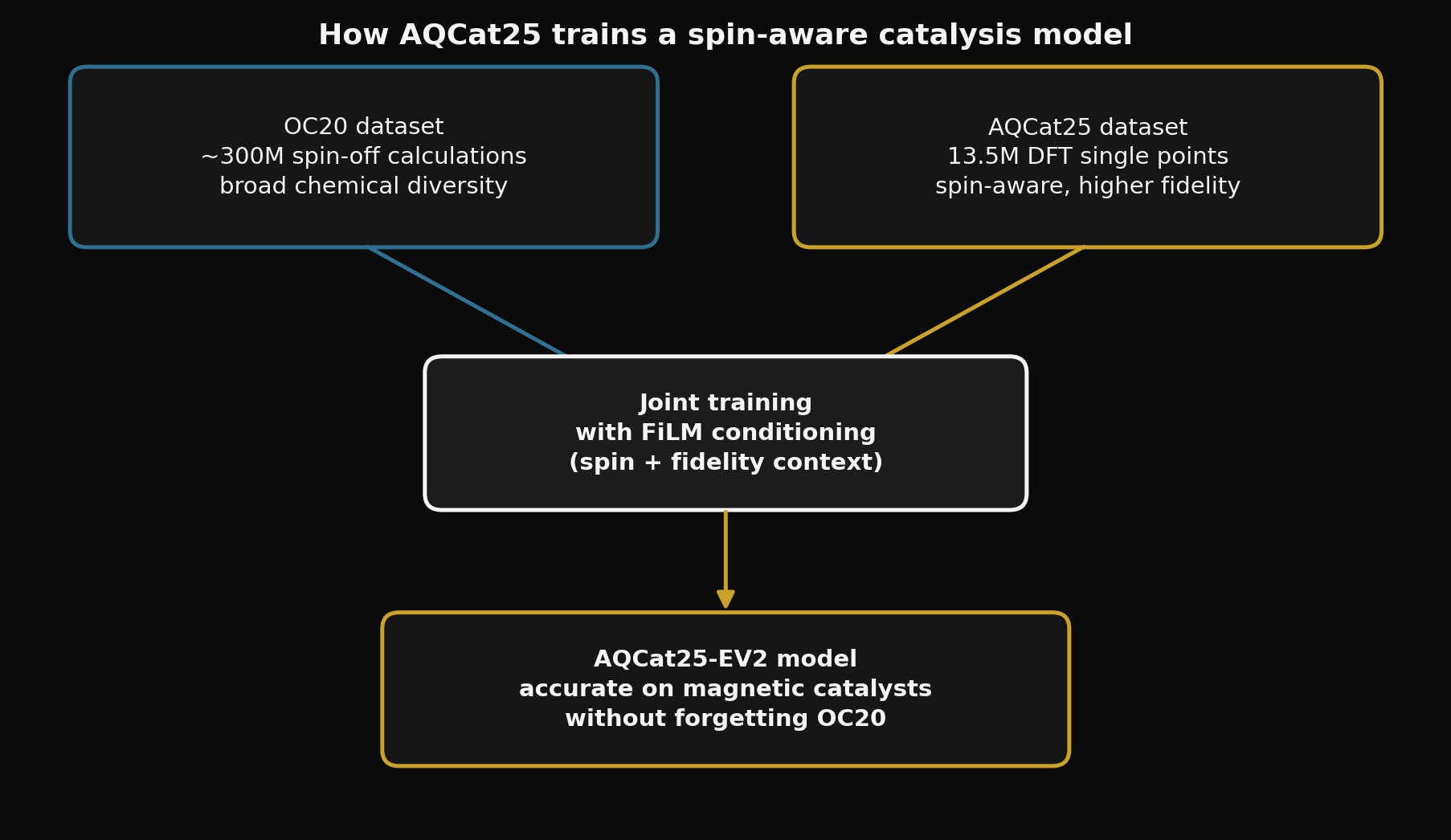
AQCat25-EV2 draws its reach from the AQCat25 dataset: 13.5 million single-point DFT calculations across 47,000 adsorbate-slab systems, computed on NVIDIA DGX H100 hardware at more than 400,000 GPU-hours. The dataset carries spin-polarized data across twelve elements and adds six that OC20 never covered: barium, cerium, fluorine, lithium, lanthanum, and magnesium. It raises the plane-wave cutoff to 500 eV with 0.1 eV Gaussian smearing, up from 350 eV in OC20 and necessary for accurate non-metal total energies. It also samples high-energy configurations on purpose, including transition states, rattled geometries, and short molecular dynamics runs, which keeps relaxations stable when they wander off the low-energy path.
That coverage shows up in the benchmark. On a screening test of 109 adsorbate-slab pairs with 50 placements each, relaxed under both DFT and ML from identical starting points, AQCat25-EV2 lands its minimum adsorption energy within 0.1 eV of the DFT minimum on 69.9% of systems at 0.12 eV MAE. The pretrained EquiformerV2 baseline reaches 48.2% at 0.28 eV on the same test. Critically, the model holds accuracy parity on general chemical space, so the spin-polarized reach comes on top of the coverage teams already expect rather than in place of it.
The AQCat25 dataset, model checkpoints, and training code are published openly for non-commercial use, and the underlying science is peer-reviewed in npj Computational Materials (read the paper).
View AQCat Adsorption Spin Model Details

