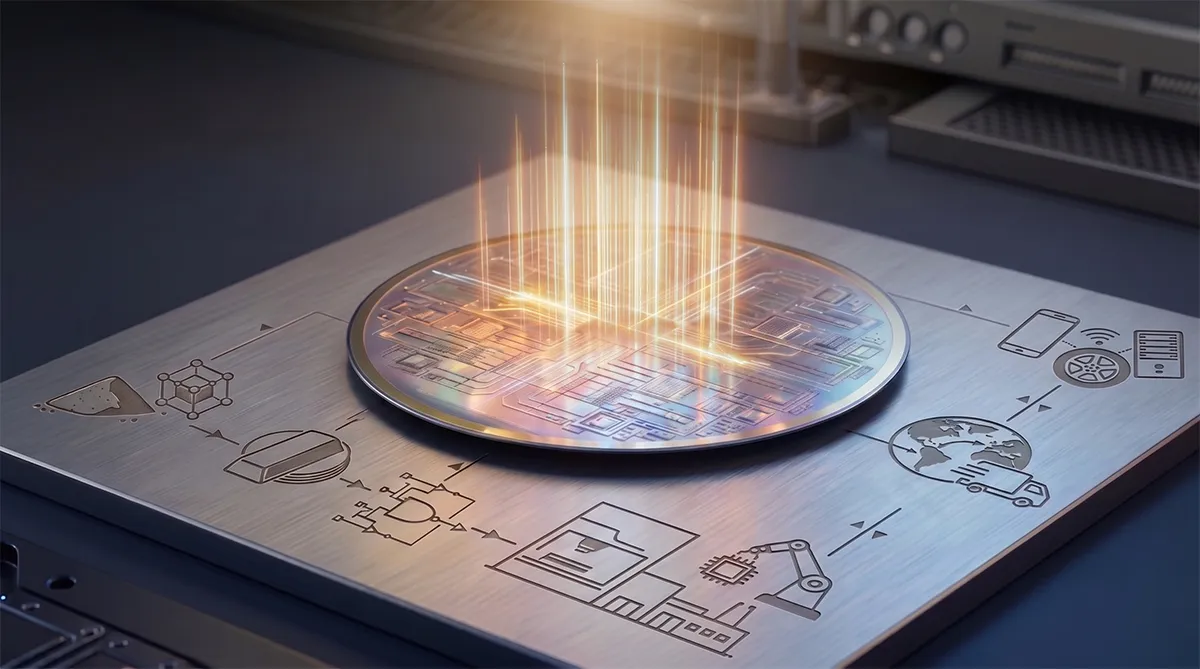
Semiconductors are a foundation of modern economic growth, powering AI, communications, and energy infrastructure. As demand rises, the United States has a strategic opportunity to build a domestic supply of the advanced materials and chemicals that make these chips possible, and to capture the resilience, productivity, and manufacturing strength that come with producing them at home.
The race now is about speed. The companies and countries that can discover, validate, and commercialize new materials faster will help set the pace for the industry. Traditional materials discovery is often too slow for the demands of AI hardware, computing, and power electronics, which continue to accelerate.
At SandboxAQ, we take a different approach from traditional materials discovery methods. We apply Large Quantitative Models, or LQMs, to semiconductor materials discovery. These models combine physics-based simulation with machine learning through a proprietary three-layer architecture. First, we generate physics-grounded data. Then we train proprietary AI and physics models on that data. Finally, we combine both in automated workflows that orchestrate full design, make, test, learn (DMTL) loops. The result is a platform built to deliver reliable answers faster and at greater scale than traditional methods alone.
SandboxAQ is deploying this capability across four critical material categories that are essential to building a stronger, more resilient U.S. semiconductor manufacturing base: PFAS-free process chemicals, catalysts, rare earth-free magnets, and battery systems.
“The next era of semiconductor leadership will be shaped not only by device architecture, but by who can invent and scale the materials that make those architectures possible. From new catalysts and PFAS-free process chemicals to advanced battery chemistries and high-performance magnets, we are entering a period where materials innovation becomes a defining strategic lever for industrial resilience and technological advantage. At SandboxAQ, we see an opportunity to fundamentally accelerate that future by combining physics-based simulation, AI, and deep industry collaboration to move breakthrough materials from discovery to real-world deployment,” said Shalini Sharma, Head of Semiconductor Materials Innovation and Cross-Vertical Strategy at SandboxAQ.

The U.S. semiconductor industry cannot achieve long-term self-sufficiency without a domestic supply of PFAS-free process chemicals. Per- and polyfluoroalkyl substances appear throughout chip manufacturing as fluoropolymers, photo-acid generators, heat-transfer fluids, lubricants, insulating coatings, and surface-treatment chemicals, and no compliant alternatives yet exist at scale. U.S. semiconductor factories that cannot qualify PFAS-free process chemicals risk simultaneous supply disruption and regulatory exposure that could force production cutbacks in newly built domestic facilities.
SandboxAQ has developed approaches to predict PFAS degradation pathways and will extend that work into a new frontier: using our LQMs and AI-accelerated materials discovery platform to identify and validate PFAS-free drop-in replacements for critical semiconductor process chemicals.

Every layer of an advanced chip is deposited using ultra-pure gases and precursors, and manufacturing those chemicals requires highly specific catalysts. The formulations and process know-how behind these catalysts are almost entirely owned and controlled by foreign suppliers. Furthermore, current production methods for semiconductor precursors are high cost and inefficient, generating excessive waste and low yields.
SandboxAQ's AQCat workflows, built on 13.5 million high-fidelity chemistry calculations developed in collaboration with NVIDIA, can screen catalyst candidates at near-quantum-chemistry accuracy 20,000 times faster than conventional methods — reducing development timelines from months to weeks. This innovation enables sustainable, cost-efficient, and ultra-pure manufacturing, which is critical for advancing the semiconductor industry toward sub-2nm nodes.

The precision motors, wafer-positioning systems, and vacuum pumps that keep semiconductor factories running rely on permanent magnets. Today, those magnets depend on rare earth elements sourced almost entirely from foreign-controlled supply chains. A disruption lasting even a few weeks can delay equipment certification and force factories to run below capacity.
SandboxAQ is using LQMs to identify magnet formulations that sharply reduce or eliminate reliance on rare earth elements. By rapidly screening vast materials spaces, SandboxAQ can accelerate the discovery of high-performance alternatives that support a more resilient semiconductor supply chain.

Semiconductor fabrication also requires uninterrupted, precisely controlled power. A disturbance lasting only minutes can force tool shutdowns, reduce yields, and trigger costly downtime. Most backup power systems in chip factories rely on battery materials– lithium, cobalt, and key chemical precursors– sourced and processed outside the United States.
To strengthen domestic supply chains and manufacturing resilience, SandboxAQ will build on its AQVolt workflows, which is a frontier AI model to accelerate the development of next-generation battery materials and energy storage technologies.
Across all four material categories, the opportunity is the same: to bring critical inputs to American chipmaking back under domestic control and move them from discovery to scale faster than ever before. The question is no longer whether the United States can build world-class domestic alternatives, but how quickly those alternatives can be discovered, validated, and commercialized.
That is exactly the work SandboxAQ is built to do. By applying Large Quantitative Models to materials discovery, we are compressing timelines that once stretched for years into weeks and helping build a more self-sufficient, globally competitive American semiconductor industry from the materials up.

