
Predicts DFT-grade spin-polarized adsorption energies and converged geometries on catalytic surfaces in seconds instead of days.
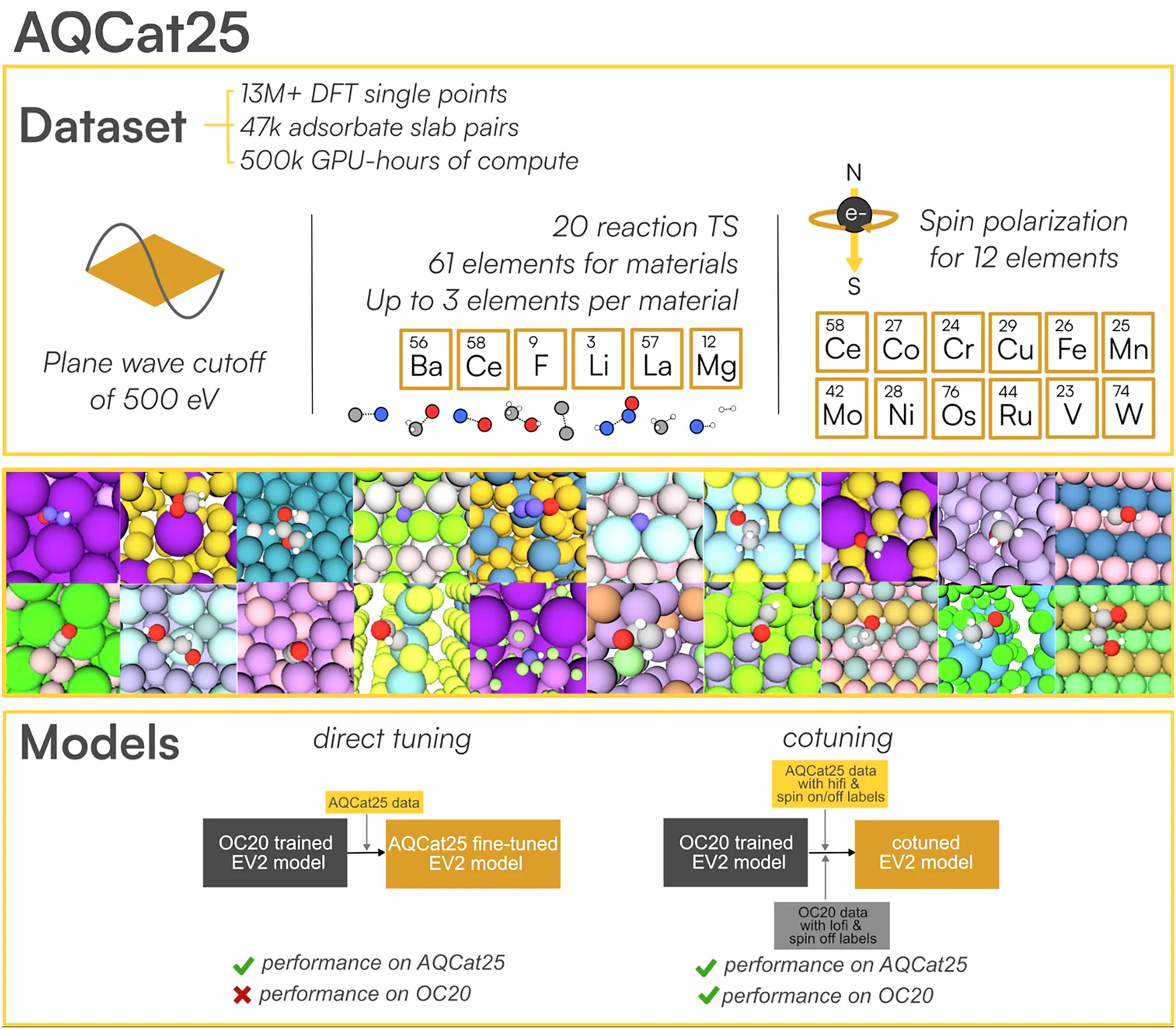
AQCat is a Large Quantitative Model for catalyst discovery, built as a machine learning interatomic potential that predicts how molecules adsorb onto catalyst surfaces, the ground-state step that determines catalyst performance. It was trained on 13.5 million high-fidelity quantum chemistry calculations spanning 47,000 catalyst systems, which lets it approach the accuracy of physics-based methods such as density functional theory while running up to 20,000 times faster. This speed changes the economics of screening: instead of the fewer than 100 candidates per week that conventional laboratory methods typically evaluate, research teams can rank vast candidate libraries computationally and reserve costly laboratory and supercomputing work for only the strongest leads.
Two design choices set AQCat apart in fidelity and reach. First, it explicitly accounts for spin polarization, a physical effect that governs the electronic structure of widely used industrial metals such as iron, nickel, and cobalt and that many comparable models omit. On general chemical space it holds accuracy parity with those models, so the spin-polarized coverage adds reach without a trade-off elsewhere. Second, it supports six additional industrially relevant elements (barium, cerium, fluorine, lithium, lanthanum, and magnesium) that are absent from other datasets, extending the model to catalysts and critical-material pathways that older methods could not reach.
Together these capabilities compress R&D timelines and de-risk investment in early catalyst screening, with direct applications in green hydrogen, sustainable aviation fuel, fertilizer production, and plastics recycling. Teams can run AQCat on demand within infrastructure they already operate, keeping every calculation inside their own environment for security and governance.
*Offer available to first-time users of the SandboxAQ MCP server only. New users receive a one-time $2,000 promotional credit applied at sign-up, redeemable solely against usage of the SandboxAQ MCP server and valid across any available model. The credit must be used within 30 days of activating your trial; any unused portion expires at the end of that period and does not roll over. The credit has no cash value, is non-transferable, non-refundable, and cannot be exchanged for cash or applied to any other product, subscription, or fee. A valid payment method is required to activate your trial. Once your $2,000 credit is exhausted, or once the 30-day period ends — whichever comes first — standard usage-based pricing applies and your payment method will be charged for continued use of the SandboxAQ MCP server. Limit one credit per individual. SandboxAQ may modify, suspend, or end this offer at any time. Offer subject to the SandboxAQ Terms & Conditions.