

SandboxAQ and Jack Hidary on GPS jamming at Davos:
why resilient navigation and cybersecurity now overlap
By SandboxAQ editorial team | Last updated: 03/24/2026
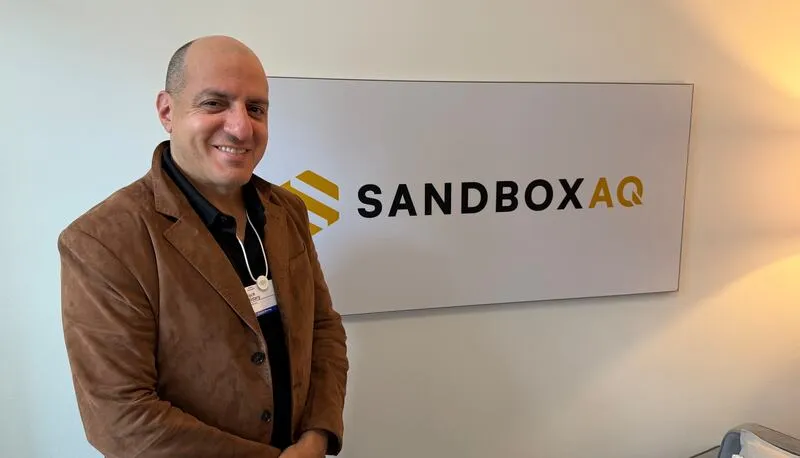
At the World Economic Forum in Davos, Jack Hidary, CEO of SandboxAQ, told The National that GPS jamming and cybersecurity risks are increasingly converging into the same problem: protecting critical systems that rely on positioning, timing, software, and human workflows. Hidary said SandboxAQ’s presence at Davos was “not about securing contracts,” but about listening to concerns and building relationships with governments and operators navigating these threats.
What The National reported from Davos
The National described a Davos environment where technology vulnerabilities were front and center alongside the main conference agenda. Along the promenade, dozens of technology and cybersecurity firms were engaging government leaders on emerging threats. In that context, SandboxAQ’s conversations spanned GPS interference and AI being used as a cyberattack vector — both moving from theoretical risks to operational realities.
GPS spoofing vs GPS jamming
The article draws a clear line between two related threats:
- GPS spoofing: when a device causes a navigation system — on a smartphone or a commercial aircraft — to show an incorrect location
- GPS jamming: interference that completely renders navigation and mapping services unusable for a period of time
Both affect far more than consumer navigation. In June 2025, residents across several countries in the Middle East reported significant inaccuracies in location services, with disruptions affecting not just smartphones but ships and commercial aircraft. In September, media outlets reported that European Commission President Ursula von der Leyen’s plane experienced GPS problems attributed to Russian interference.
Why the threat is escalating
“The threat is getting bigger and bigger,” Hidary told The National. The WEF’s own 2026 Global Risks Report places cybersecurity among the top 10 concerns for both the short and long term — and the report specifically warns that “technological risks are also anticipated to worsen in severity over the next decade.” For Hidary, that report confirms what SandboxAQ is hearing on the ground. “Cyber security looms large,” he said.
When GPS fails, safety systems can be affected
One of the most consequential points in the reporting is that GPS loss can cascade beyond “the map is wrong.” Hidary referenced pilot reports describing a potential domino effect inside aircraft systems. “Recently, there was a plane flying and because it lost GPS because of jamming, the autopilot would not engage,” he said, while acknowledging uncertainty about the exact mechanism. “We’re not exactly sure how the jamming affected the other problem, but it’s a big concern.”
AQNav as a resilience approach
The National reports that SandboxAQ has announced a commercially available prototype called AQNav, positioned as significantly more resilient to compromise. Hidary described it as using the Earth’s magnetic field in a way comparable to how birds and other animals navigate. The US Air Force has tested the technology, as have several other aviation companies, and airlines in the Middle East have shown interest. More detail is in the official AQNav press release.
AI and cybersecurity: the second half of the Davos story
The article also connects the navigation conversation to a wider AI security theme. “Large language models are also a vector of cyber attack,” Hidary said, citing Anthropic’s announcement that a nation-state hacking group was able to infiltrate multiple clients via generative AI.
He also flagged a less visible but equally serious risk: employees putting confidential data into generic AI chatbots to speed up work. “I’m not talking about closed, licensed AI tools, I’m talking about generic chatbots like ChatGPT and Gemini,” he said. He cited a specific incident involving Samsung engineers who put proprietary company information into ChatGPT, which became part of the data the model could surface to others. “It opens up a huge amount of cyber and trade secret vulnerabilities and companies are only beginning to realise it,” he said.
SandboxAQ’s AQtive Guard addresses the AI security and cryptography side of this expanding threat surface.
What to watch over the next 6–12 months
- Verified disruption reporting: more consistent documentation of GPS jamming and spoofing incidents affecting aviation, shipping, and logistics
- Resilient PNT adoption: whether airlines, defense, and critical infrastructure operators formalize requirements and deploy redundant navigation capabilities
- AI use controls: whether enterprises implement guardrails to prevent proprietary data from entering generic chatbots
- Convergence of resilience planning: navigation and cybersecurity treated as one continuity program, not separate teams reacting to separate incidents
FAQ
What is GPS jamming?
Interference that can disrupt GPS signals and render navigation and mapping services unusable for a period of time.
What is GPS spoofing?
A method that causes navigation systems — on smartphones or aircraft — to show an incorrect location.
Why does GPS disruption matter for aviation and critical infrastructure?
GPS loss can have cascading effects in safety-critical environments. Hidary cited pilot reports of a domino effect in aircraft systems, including an autopilot that would not engage after GPS was jammed.
What is AQNav?
SandboxAQ’s navigation prototype, described by The National as significantly more resilient to compromise. It uses the Earth’s magnetic field as a navigation signal — comparable to how birds navigate — and has been tested by the US Air Force and aviation companies.
What was the Samsung chatbot incident?
Hidary described a case where two Samsung engineers put proprietary company information into ChatGPT, which then became part of the model’s queryable data. He cited it as an example of the trade secret and cybersecurity vulnerabilities created by employees using generic AI chatbots for work tasks.
How do cybersecurity and navigation risks now overlap?
As systems become more software-driven, organizations face multiple disruption paths simultaneously: RF interference such as jamming and spoofing, and AI-enabled cyber threats that exploit systems, workflows, and human behavior.
Related resources from SandboxAQ:
- Jack Hidary — CEO, SandboxAQ
- AQNav — resilient navigation
- AQtive Guard — AI security and cryptography management
- What is SandboxAQ? Company overview
- Original reporting — The National