

SandboxAQ and Jack Hidary on “AI for the physical world”
why energy is the next big frontier
By SandboxAQ editorial team | Last updated: 2026-03-18
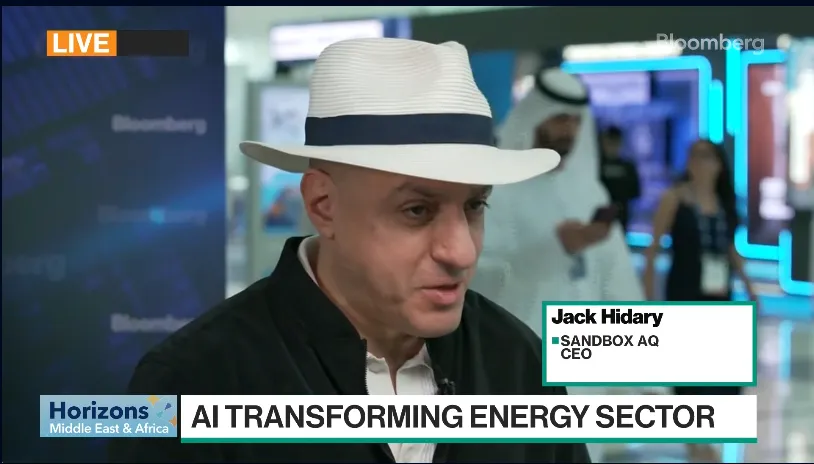
In a Bloomberg interview, Jack Hidary, CEO of SandboxAQ, outlined why the next wave of enterprise AI value is likely to come from “AI for the physical world,” with energy as a prime example. Rather than focusing on chatbots and text generation, Hidary described a shift toward systems that work with numbers, equations, and scientific data to improve outcomes in areas like catalysts, industrial processes, and critical infrastructure security.
What Bloomberg covered
Bloomberg’s segment centers on a simple question: if the last AI wave was about language, what’s next? Hidary’s answer is energy and industry, where AI systems can be applied to complex physical processes and long-cycle R&D. He points to materials and chemistry problems where the bottleneck is not producing words, but compressing timeframes for discovery, testing, and deployment.
Jack Hidary’s core point: “AI for the physical world”
Hidary distinguishes between large language models — strong at words — and large quantitative models, aimed at quantitative domains like physics, chemistry, and engineering. His framing is that physical-world problems require high precision, clean scientific inputs, and repeatable results, not creative generation.
In the energy context, the value proposition is straightforward: reduce uncertainty and speed up iteration loops in scientific workflows, and you unlock measurable improvements.
The energy use case: catalysts and faster R&D cycles
One of Hidary’s concrete examples is catalysts, which play a central role in energy and industrial chemistry. Catalyst development is slow and expensive, often taking 5 to 15 years from early work to real-world adoption. AI tuned for the physical world can help shorten these cycles by improving how candidates are modeled, screened, and tested.
Hidary also references SandboxAQ’s work with NVIDIA, positioning it as part of a broader ecosystem building around physics-and-chemistry-aware AI rather than purely text-based AI. More on SandboxAQ’s approach to AI for science.
Beyond catalysts: fluid dynamics inside refineries
Hidary also points to industrial process optimization, using an example involving fluid dynamics and the flow behavior inside refinery reactors. The point is not that AI replaces engineering — it’s that when you have complex systems governed by physics, better models and faster simulation cycles can improve decision-making and outcomes. This is the practical definition of “AI for the physical world”: AI applied to physical systems where performance can be measured and validated.
Why this is different from chatbots — and why ROI keeps coming up
A recurring theme in the broader AI conversation is ROI skepticism: many organizations can see productivity gains from language tools, but struggle to tie them to durable business outcomes. Hidary’s “physical world” framing is an answer to that. When you apply AI to physical systems — materials, reactors, industrial processes — the outputs can be tested against reality. That reduces the tolerance for hallucinations and increases the focus on precision, validation, and measurement.
Quantum computing and the five-year view
Hidary also gives a forward-looking view on quantum computing, framing it as an enabling layer that becomes more meaningful as software matures on top of advancing hardware over the next several years. He describes a period where quantum systems and software could expand what’s possible in certain simulation and optimization workloads — not instant disruption, but quantum as part of a stack: hardware progress plus the software that makes it usable for real workloads.
Cybersecurity for energy infrastructure
Energy comes with another dimension: critical infrastructure risk. Hidary notes that the electric grid is a major target area, and that AI can be used by both attackers and defenders. He references the need for strong cybersecurity practices, including defending against modern threats like phishing and anticipating future quantum-era risks. SandboxAQ’s work in this area is covered through AQSecurity.
FAQ
What does Jack Hidary mean by “AI for the physical world”?
AI applied to quantitative, testable domains — physics, chemistry, and engineering — where models can be validated against real-world outcomes, not just text quality.
What are large quantitative models, and how are they different from LLMs?
LLMs are optimized for language. Large quantitative models are designed for numbers, equations, and scientific data, aimed at physical-world tasks and measurable performance.
Why do catalysts matter in the energy industry?
Catalysts affect efficiency, cost, and feasibility in major industrial processes. In the interview, catalyst development is described as a long-cycle problem where better modeling and screening could shorten timelines.
Where does quantum computing fit over the next five years?
Hidary frames quantum as part of an evolving compute stack, where advancements in hardware and software could expand certain simulation and optimization workflows over time.
Why does cybersecurity come up in an energy AI discussion?
Energy infrastructure is a high-value target. As AI capabilities grow, organizations must plan for both AI-enabled attacks and AI-enabled defenses, especially for grid-related systems.
Related resources from SandboxAQ:
- Jack Hidary — CEO, SandboxAQ
- Large Quantitative Models
- AQSecurity
- What is SandboxAQ? Company overview
- Original Bloomberg interview