By Stefan Leichenauer
The White House’s new Executive Order on Quantum Innovation is a flagship moment for the sector, a clear signal that the United States intends to lead across every dimension of quantum: computing, communications, and sensing. Executive Order 14411 directs a whole-of-government effort to accelerate the commercialization and deployment of these capabilities.
In the last 24 months, there has been significant progress both in quantum computing and in quantum sensing. Multiple quantum computing modalities have achieved their milestones, and quantum sensors are now being deployed in real-world applications. U.S. global competitiveness now depends not just on our AI technology, but on our quantum assets. Other countries have been pouring resources into such advances as well; this Executive Order comes at a crucial point to marshal U.S. forces in this area.
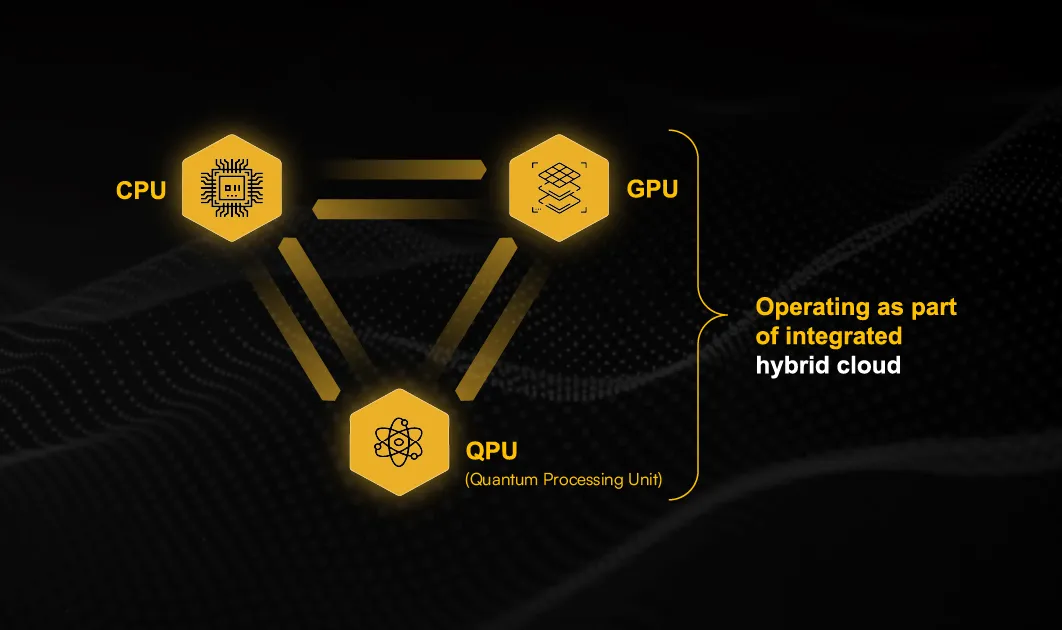
At SandboxAQ, we have been preparing for this moment since our earliest days. We recognized something that was not yet widely appreciated: quantum and AI would mature together. Not on separate timelines, but in convergence. That insight drove two parallel efforts. First, we raised the alarm on the need for post-quantum cryptography (PQC), publishing in Nature and working with enterprises and governments to begin the migration well before it became a policy priority. Second, we began building a platform that could translate quantum principles into real-world applications, long before large-scale quantum computers arrived. Today, that vision is playing out with a platform built around this convergence and is how we convert quantum leadership into enduring strategic advantage:
This approach allows us to move beyond theory into deployment.
We’re already applying these capabilities across critical sectors. In biopharma and materials science, our LQMs are accelerating discovery cycles by simulating molecular interactions and predicting behaviors with unprecedented speed and accuracy. In navigation, our AQNav platform uses advanced sensors and AI to supplement GPS whose signals can be jammed or spoofed – addressing a growing national security imperative and commercial aviation challenge. In healthcare, our magnetocardiography system is targeting the #1 cause of death globally, using AI and sensors to enable earlier and more precise detection of cardiac events. These are not future use cases – they are present-day systems addressing real-world challenges. Their existence accentuates the next evolution in AI that’s happening as we speak.
Large Language Models (LLMs) have transformed how we interact with digital information. The next wave is about LLMs interacting with the physical world – through LQMs LLMs excel at simplifying language-based tasks but are not designed for quantitative tasks. LQMs excel at scientific discovery, but are highly complex and require significant domain expertise to use efficiently. By combining the two models, we’ve unlocked the potential to drive innovative new breakthroughs in drug discovery, materials science, and other industries through the power of natural language queries.
For C-suite leaders and government officials, the implications are profound. Hybrid LLM-LQM models will rapidly deliver core innovation in the form of new drugs, new materials, new energy solutions, and more resilient infrastructure – not just simple process optimization. They will enable the creation of multidisciplinary R&D teams composed of people who have the best ideas, not just those with PhDs – who are in global demand and short supply. Such expanded teams will act as a force-multiplier for innovation, enabling parallel work streams and tapping into AI resources and datasets previously only accessible to data scientists and domain experts
AI and quantum have a symbiotic relationship, each one supercharges the capabilities of the other. Right now, AI has matured faster than quantum, thanks to rapid advances in GPUs, machine learning, deep learning, and other technologies, but quantum is coming faster than we think. Advances in algorithms and error correction are lowering the qubit threshold at the same time hardware continues to scale. As research from Google recently demonstrated, the timeline for a computationally-relevant quantum computer has moved up by six years. And while this hastens the deadline for Q-Day, it is also a welcome moment for scientific exploration and future innovation.
The United States has a window of opportunity to lead in this domain. It requires coordinated investment across the stack: cryptography, compute infrastructure, data generation, and application development. It also requires strong partnerships between government, industry, and academia to focus our resources and talent towards a common goal. The new White House Executive Order on quantum will provide the spark needed to stimulate quantum leadership and innovation in the years to come.

