Predicts protein-ligand potency (pIC50) without 3D structures in seconds, featuring confidence-aware scoring and off-target screening.
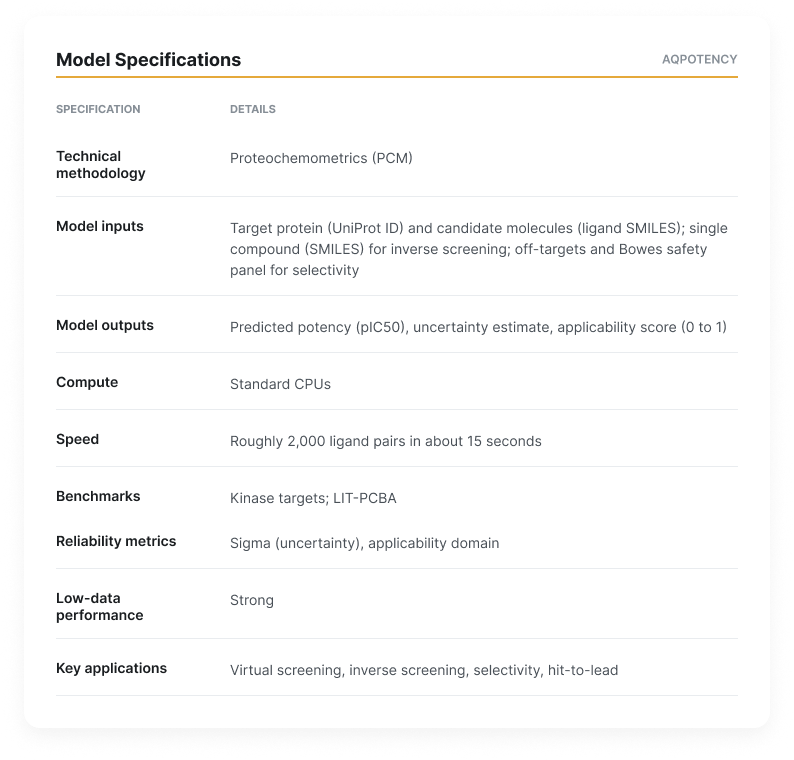
AQPotency is a Large Quantitative Model for drug discovery, built to rank protein-ligand pairs by predicted binding affinity (pIC50). Traditional virtual screening leans on docking and physics-based free energy perturbation, workflows that demand an experimentally resolved 3D structure of the target, and heavy compute. AQPotency lifts these constraints: it takes only a target UniProt ID and a set of candidate molecule SMILES strings, runs on standard CPUs, and scores pairs in seconds for as little as $1 per 1,000. Research teams can therefore rank enormous compound libraries in hours and reserve wet-lab effort for the candidates most likely to matter. On leakage-controlled virtual-screening benchmarks, its early-enrichment ranking is statistically equivalent to physics-based docking, at far higher throughput and lower cost.
Two design choices set AQPotency apart. First, it predicts potency without a solved structure, so it opens programs that structure-based methods cannot reach, including membrane targets and proteins that have never been crystallized. Second, every prediction carries a per-prediction uncertainty estimate and an applicability-domain score between 0 and 1 that flags whether a molecule falls inside the chemical space the model actually knows. That score comes from a built-in applicability-domain and exploratory-data-analysis tool, which also lets teams check for data leakage and benchmark the model against their own data, transparency that opaque scoring tools do not provide. Unlike conventional scoring approaches that return a single number, this confidence layer tells scientists not just what the model predicts, but which rankings to rely on.
Run forward, AQPotency screens a library of candidates against a target and ranks them by predicted potency and can calculate selectivity with off-target analysis. Run in reverse, it scans a single compound across a proteome-wide panel and turns a phenotypic hit into a ranked, confidence-aware list of candidate targets. The model also supports selectivity analysis across target families and off-target scans such as the kinome and Bowes safety panels, covering virtual screening, inverse screening, selectivity, and hit-to-lead work.