Designed to surface safety surprises early, and explain why
AQCELL · Drug discovery

AQCell is designed to show why cells die and why compounds rank as they do, so your team can trust the reasoning and commit to experiments with confidence.

SandboxAQ’s virtual cell model predicts how a compound changes gene expression, pathways and cell viability, so teams can choose what to test first.

Talk to our team

Tell us about your program and our drug discovery team will be in touch.

What goes wrong late

The costliest surprises come late.

01

Most drug candidates that reach the clinic never reach approval.¹

02

Safety problems are among the reasons late-stage programs fail.²

03

Teams need to see why a compound works, and what it might do to other cells, such as liver cells.

AQCell is designed to give that signal earlier.

WHAT AQCELL IS DESIGNED TO REVEAL

One model, from compound to cell response.

01

Predict the response

Gene expression and pathway activity, from a compound, dose and time, and a cell’s baseline state.

02

Predict the outcome

Endpoints such as cell viability and hepatic endpoints, including drug-induced liver injury (DILI) risk, predicted alongside that biology.

03

Explain the why

Predictions are designed to trace back to biological pathways.

Inside the model

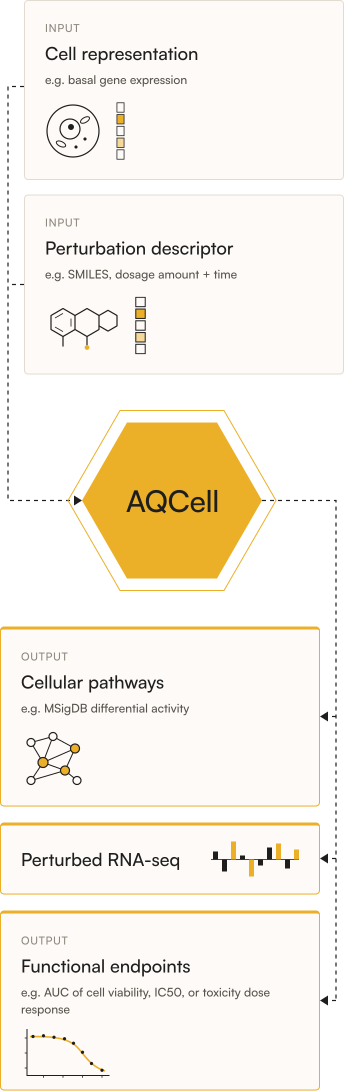
AQCell is designed to predict both chemical perturbations and functional endpoints.
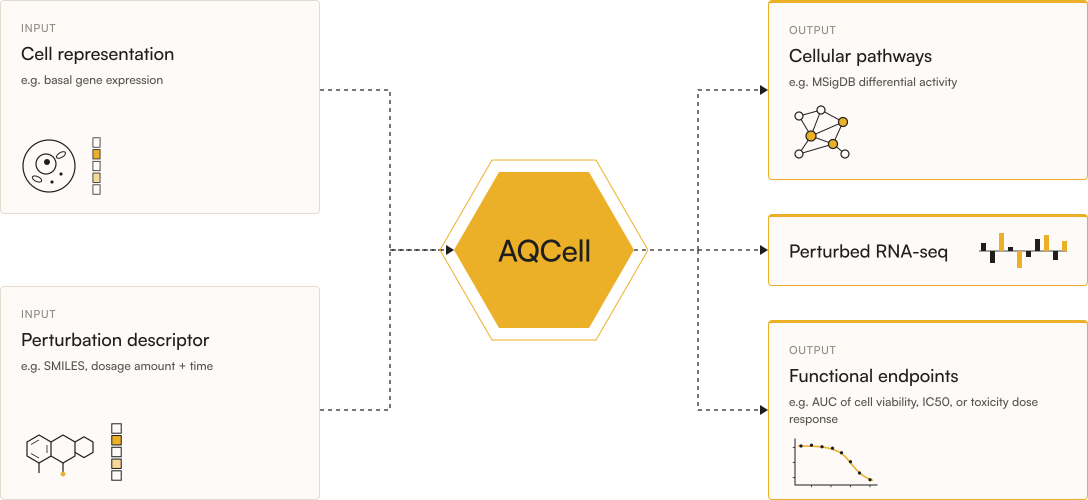
AQCell architecture: a cell representation, a knowledge graph and a perturbation descriptor feed the AQCell model, which predicts cellular pathways, perturbed RNA-seq and functional endpoints.AQCell architecture: a cell representation, a knowledge graph and a perturbation descriptor feed the AQCell model, which predicts cellular pathways, perturbed RNA-seq and functional endpoints.
What sets it apart

Why AQCell is designed to be different.

01

Response and outcome in one model

Published perturbation models predict gene-expression changes.³ AQCell goes on to predict an endpoint.

02

Built to use the compound

A published analysis found that leading models make little use of drug features on new compounds.³ AQCell is designed to tell compounds apart.

03

Explains itself

Pathway-level predictions sit alongside the endpoint predictions, so results can be traced to biology.

04

Learns from your data, privately

Fine-tune AQCell on your own data inside your own environment.

What partners can bring

The Virtual Cell Network.

Through the Virtual Cell Network, powered by Apheris, drug development teams can leverage federated learning to refine AQCell using their private biological datasets securely. Uncovering critical safety and efficacy signals earlier allows research groups to prioritize the right leads and make confident, data-backed assay decisions.4

Learn about the Virtual Cell Network
1

Start from the AQCell base model

Access AQCell through AWS Marketplace or Apheris Foundry.

2

Adapt it to your data

Fine-tune on your own assays, or join the Virtual Cell Network to also train on data from across the industry. Your data never leaves your environment.

3

Keep improving

Continue fine-tuning as new results arrive.

Who’s behind it

Why SandboxAQ

Born at Alphabet in 2022, SandboxAQ brings computational chemistry, medicinal chemistry, biology, bioinformatics and AI together in one drug discovery team.

What partners say about SandboxAQ

“

With SandboxAQ’s platform, we increased the chemical exploration space from 250,000 molecules to 5.6 million. We identified candidate molecules faster and more efficiently with a hit rate 30 times greater.

Dr. Stanley Prusiner
Nobel Laureate, UCSF
“

This undruggable protein target has been by far our toughest drug discovery target to date. Having enabled medicinal chemistry on multiple promising starting points is an enormous achievement and extremely exciting.

Dr. Klaus Klumpp
Co-Founder and President of Riboscience
“

SandboxAQ’s leapfrog technology could significantly impact both preclinical and clinical development of drugs, and we look forward to seeing how it could support us in delivering life-changing treatments to patients worldwide, faster.

Paul Hudson
Former CEO of Sanofi

Tell us your endpoint and the decision you need to make.

References
  1. BIO, Informa Pharma Intelligence and QLS Advisors. Clinical Development Success Rates and Contributing Factors 2011–2020. February 2021. https://www.bio.org/clinical-development-success-rates-and-contributing-factors-2011-2020
  2. Harrison RK. Phase II and phase III failures: 2013–2015. Nature Reviews Drug Discovery 15, 817–818 (2016). https://doi.org/10.1038/nrd.2016.184
  3. Bai J, Prince S, Nitschke GS. Deep learning models for chemical perturbation prediction do not yet utilise drug molecular features. bioRxiv preprint (2026), not peer reviewed. https://doi.org/10.64898/2026.05.13.724458
  4. Apheris. AI Structural Biology Network (federated training: models train inside each member’s environment; only model updates are aggregated). https://www.apheris.com/networks/aisb