

Computational Drug Discovery:
What It Is and Why It Matters
Developing a new drug costs an average of $2.23 billion and takes 10 to 15 years — and roughly 90% of candidates that enter clinical trials still fail. The leading causes of failure are not manufacturing problems or regulatory delays. They are scientific ones: compounds that lack efficacy in humans, compounds that are toxic in ways preclinical models did not predict, and compounds with poor pharmacokinetic properties that make them unusable at therapeutic doses. Computational drug discovery is the field of methods and tools designed to identify and address these problems before expensive clinical programs are underway. AQBioSim applies physics-grounded quantitative AI across the discovery pipeline to improve candidate quality at every stage.
What computational drug discovery means
Computer-aided drug design — CADD — has been part of pharmaceutical R&D for decades. What changed in the past several years is the scale at which it operates. Earlier computational methods could screen thousands or tens of thousands of compounds against a target of interest. Current approaches can screen virtual libraries containing billions of compounds. The flood of structural biology data from cryo-electron microscopy and AI-based protein structure prediction, combined with advances in computing infrastructure and machine learning, has made it practical to explore chemical space at a scope that no physical screening program could match.
The 2024 Nobel Prize in Chemistry, awarded to David Baker, Demis Hassabis, and John Jumper for computational protein design and protein structure prediction, marked the field’s arrival as a foundational scientific discipline rather than a supporting tool. That recognition matters practically: when protein structures can be predicted reliably, the number of targets accessible to structure-based computational methods expands dramatically.
The goal of computational drug discovery is not to replace experimental science. It is to decide which experiments are worth running. A well-designed computational workflow does not eliminate failure — it makes the failures cheaper by catching them earlier and concentrating wet-lab resources on the candidates most likely to succeed.
The core methods
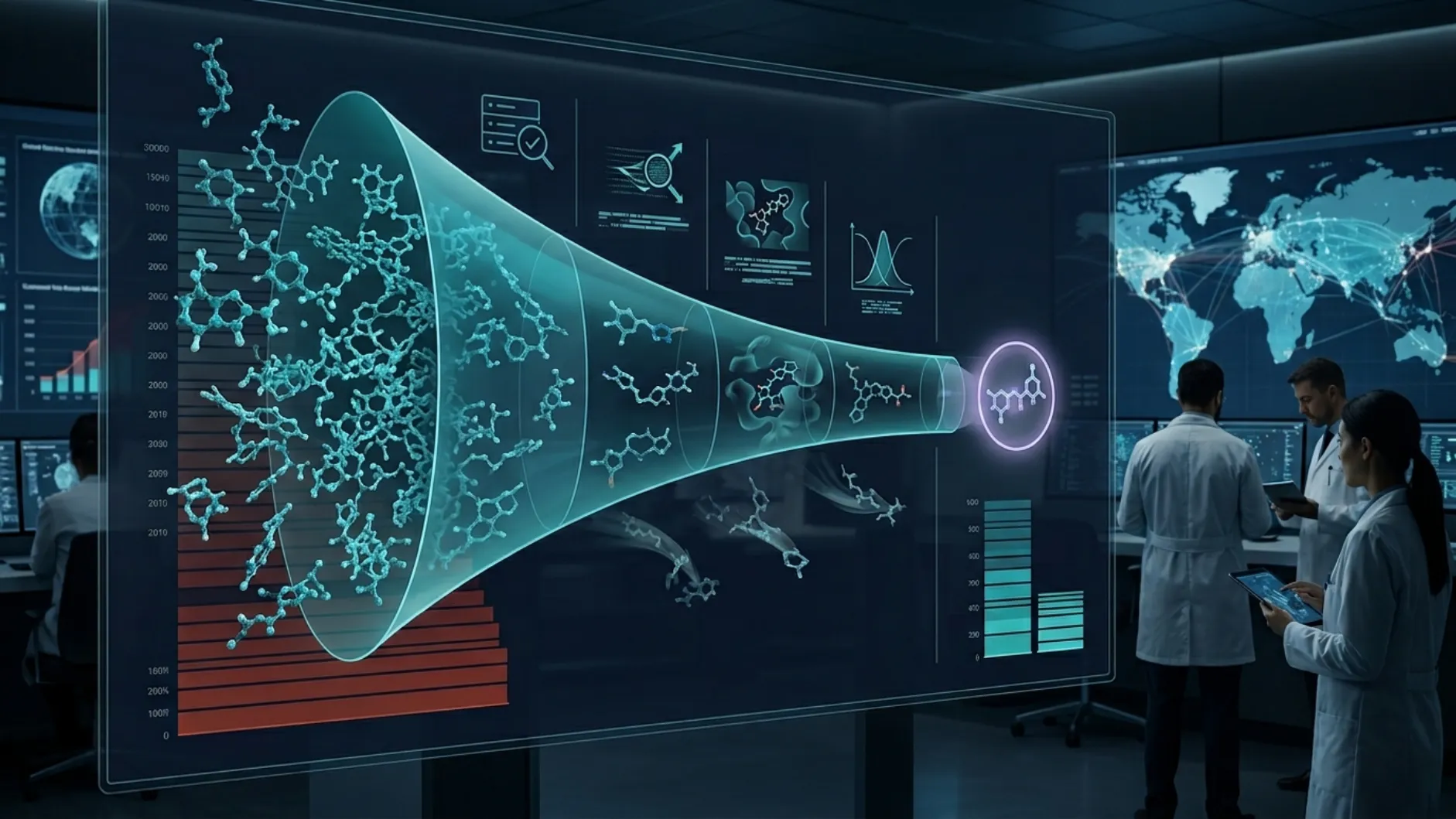
Computational drug discovery is not a single technique. It is a collection of methods, each suited to different points in the pipeline and different types of questions.
Structure-based virtual screening starts with the three-dimensional structure of a protein target and uses it to search large compound libraries for molecules that might bind to the target’s active site. Rather than physically testing thousands of compounds in an assay, computational screening ranks them by predicted binding potential and passes only the most promising to experimental confirmation. This is where the scale advantage of computation is most visible: virtual libraries now contain billions of compounds that would take lifetimes to screen physically.
Molecular docking goes a step further. Once candidate compounds are identified, docking models predict the precise three-dimensional pose — the orientation and fit — of a compound within the binding site. This gives medicinal chemists a structural picture of the interaction, which informs how to modify the compound to improve it. Docking is fast relative to experimental structure determination, though it trades some accuracy for that speed.
Molecular dynamics simulation models how molecular systems behave over time. Rather than treating a protein as a static structure, MD simulations capture the flexibility and conformational changes that happen as proteins move — which matters because drug binding is a dynamic process, not a static lock-and-key event. MD is computationally intensive, but it provides information that docking and virtual screening cannot.
Quantitative structure-activity relationship modeling — QSAR — uses statistical relationships between molecular structure and measured biological activity to predict the properties of new compounds. If you know how a series of related molecules perform in an assay, QSAR models can estimate how a new analog will perform before you make it. It is fast and interpretable, and most useful when working within a well-characterized chemical series.
Free energy perturbation — FEP — is the most accurate and computationally demanding of the core methods. It calculates the free energy difference between two molecular states: for example, how much more or less tightly a modified compound binds compared to a reference molecule. FEP results are closer to experimental measurements than docking or QSAR predictions, which is why it is used for the highest-stakes decisions in lead optimization — choosing which analog to advance when the differences between candidates are small.
ADMET prediction applies computational models to estimate how a compound will be absorbed, distributed, metabolized, and excreted, and whether it is likely to be toxic. Flagging ADMET liabilities early — during lead optimization rather than after clinical entry — is one of the clearest ways computational approaches reduce late-stage attrition.
What the data says about where computational methods help most
The 90% clinical failure rate breaks down into specific causes, and computational methods address different ones with different degrees of effectiveness. Lack of efficacy accounts for 40 to 50% of clinical failures; toxicity for roughly 30%; poor drug-like properties for 10 to 15%. Computational methods that improve compound selection — better hits, better analogs, earlier toxicity flagging — directly address the first two categories, which together account for the large majority of failures.
The attrition funnel makes the economic case clearly. Of every 5,000 compounds entering preclinical screening, roughly five advance to clinical trials, and only one is approved. Most of that attrition is not random — it reflects systematic limitations in how candidates are selected. Computational methods compress the funnel by enriching the set of compounds that reach experimental testing, not by eliminating experimental testing altogether.
The enrichment effect is measurable. Research published in 2025 found that integrating pharmacophoric features with protein-ligand interaction data in computational workflows boosted hit enrichment rates by more than 50-fold compared to traditional screening methods. That kind of improvement does not come from working harder — it comes from starting with better candidates.
The limits of statistical approaches — and what physics-based simulation adds
Most computational drug discovery methods share a common dependency: they learn from historical experimental data. QSAR models require measured activity data for related compounds. Docking scoring functions are calibrated on known protein-ligand complexes. Even many deep learning-based virtual screening tools are trained on existing bioactivity databases. This works well when the target and chemical space are well-characterized — when there is enough prior data to learn from.
The harder cases — novel targets, rare diseases, first-in-class molecules with no close structural precedent — are exactly where historical data is thinnest. A QSAR model trained on kinase inhibitors does not transfer reliably to a novel receptor class. A docking scoring function calibrated on soluble proteins may perform poorly on membrane proteins with unusual binding geometries. The data-dependence of statistical methods is not a flaw in any particular implementation; it is a structural property of how they work.
Physics-based simulation addresses this differently. Rather than learning correlations from historical records, it models molecular behavior from first principles: quantum mechanics, thermodynamics, and the laws of chemistry. A quantum chemistry calculation does not need prior experimental data for a target — it computes the electronic structure of the system directly. That means it can generate reliable predictions in novel chemical spaces where statistical methods have no signal to work from.
SandboxAQ’s Large Quantitative Models combine physics-based simulation with AI to deliver predictions at a speed and scale that pure quantum chemistry cannot match alone. The models are trained on physics, chemistry, and biology rather than on historical bioactivity data, which is what allows them to operate in the hard cases — novel targets, sparse data environments, and first-in-class chemical spaces where conventional approaches struggle. For more on the distinction between statistical machine learning and quantitative AI in this context, see the companion article on machine learning in drug discovery.
How computational drug discovery fits into a modern pipeline
Computational methods are not confined to a single stage of discovery. The strongest programs integrate them across the full pipeline, using each method where it is best suited.
At the earliest stage, target identification and validation, computational analysis of genomic, proteomic, and structural data helps prioritize which biological targets are most likely to be druggable and most relevant to the disease mechanism. This is increasingly an AI-driven problem as multi-omics datasets grow in scale.
Virtual screening handles the first pass across chemical space: narrowing billions of candidate compounds to a manageable set for experimental testing. The quality of this filtering directly determines the quality of what enters the hit-to-lead process. A better virtual screen means a better hit set, which means better starting points for optimization.
Lead optimization is where the most intensive computational work happens. QSAR models, molecular dynamics, and FEP-based methods work iteratively with medicinal chemists to propose modifications, predict their effects, and prioritize which analogs to synthesize. The feedback loop between computational prediction and experimental measurement is what makes this phase work — neither approach alone is as effective as the combination.
ADMET and safety assessment runs in parallel throughout, not only at the end. Compounds flagged early for likely hepatotoxicity, hERG liability, or metabolic instability can be deprioritized before significant resources are committed to them — which is the entire point.
Candidate selection draws on all of the above: the compound that advances to clinical development is the one that best satisfies the full set of requirements, not just the one with the highest potency. Computational models that integrate binding affinity, selectivity, ADMET profile, and synthetic accessibility into a single assessment give decision-makers a clearer picture than any single assay result.
Evaluating computational drug discovery platforms
The relevant questions differ from what most vendor conversations focus on. Features matter less than the specific failure modes a platform handles well.
The first question is about data requirements. Many platforms perform well when training data is abundant — well-characterized targets, large bioactivity datasets, established chemical series. The harder test is performance on novel targets with limited prior data. A platform that cannot operate reliably in sparse data environments is limited to the easier problems, which are also the more competitive ones.
The second question is about physics grounding. Statistical and physics-based approaches are genuinely different in how they handle unexplored chemical space. Asking whether a platform incorporates first-principles simulation — and not just ML trained on existing data — is not a technical detail. It determines whether the platform can be used for first-in-class discovery or only for incremental optimization within known series.
The third question concerns experimental feedback. A platform that produces predictions but cannot incorporate experimental results to improve future predictions will plateau. The programs that compound over time are the ones where the computational and experimental workflows are genuinely integrated — where each lab result becomes an input that makes the next prediction more reliable.
External validation is the last thing to examine, and the most important. Published peer-reviewed results, named partner case studies, and independently reproducible performance claims carry weight that internal benchmarks do not. AQBioSim’s results — including a 30-fold hit rate improvement and a 5.6 million molecule exploration space at UCSF, and validated performance on historically undruggable targets in neurodegeneration and oncology — are documented in published manuscripts and named case studies.
FAQ
What is computational drug discovery?
Computational drug discovery, also called computer-aided drug design (CADD), is the use of molecular modeling, simulation, machine learning, and related computational methods to identify and optimize drug candidates. It covers the full pipeline from target identification and virtual screening through lead optimization, ADMET prediction, and candidate selection, with the goal of improving candidate quality and reducing the cost and time of experimental programs.
How does computational drug discovery reduce costs?
Primarily by catching failures earlier. The 90% clinical failure rate reflects problems — lack of efficacy, toxicity, poor drug-like properties — that are expensive to discover in clinical trials and cheaper to identify computationally during lead optimization or preclinical screening. Virtual screening also reduces experimental burden by enriching the compounds selected for physical testing, so fewer resources are spent on candidates unlikely to succeed.
What is the difference between molecular docking and free energy perturbation?
Molecular docking predicts the binding pose of a compound in a protein’s active site and estimates whether it will bind — it is fast and useful for large-scale screening. Free energy perturbation (FEP) calculates the actual thermodynamic binding free energy between a compound and its target with much higher accuracy. FEP is far more computationally demanding and is used later in lead optimization, when the differences between candidate compounds are smaller and the decision consequences are higher.
What is CADD?
CADD stands for computer-aided drug design. It is the umbrella term for computational methods used across the drug discovery pipeline, including molecular docking, virtual screening, QSAR modeling, molecular dynamics simulation, free energy perturbation, and ADMET prediction. The field has existed for decades but has expanded dramatically in scope and impact with AI, structural biology data, and high-performance computing.
How does AI improve computational drug discovery?
AI methods accelerate and improve several stages: virtual screening at scale, property prediction (solubility, toxicity, permeability), de novo molecule design, and the analysis of complex biological data for target identification. The most significant recent development is AI-based protein structure prediction, which has expanded the number of targets accessible to structure-based computational methods. The practical limit is data dependence — AI methods perform best when prior experimental data for the target and chemical series is available.
What is physics-based simulation and how does it differ from machine learning in drug discovery?
Machine learning learns patterns from historical experimental data. Physics-based simulation models molecular behavior from first principles — quantum mechanics and thermodynamics — and does not require historical bioactivity data to produce predictions. The practical difference is generalizability: statistical ML methods degrade on novel targets and unexplored chemical spaces, while physics-based methods can operate there by design. SandboxAQ’s Large Quantitative Models combine physics-grounded simulation with AI to deliver accuracy at production speed.
Explore SandboxAQ’s computational drug discovery capabilities:
- AQBioSim — end-to-end AI drug discovery platform
- Large Quantitative Models — physics-grounded quantitative AI
- AQChemSim — chemistry and materials simulation
- SandboxAQ