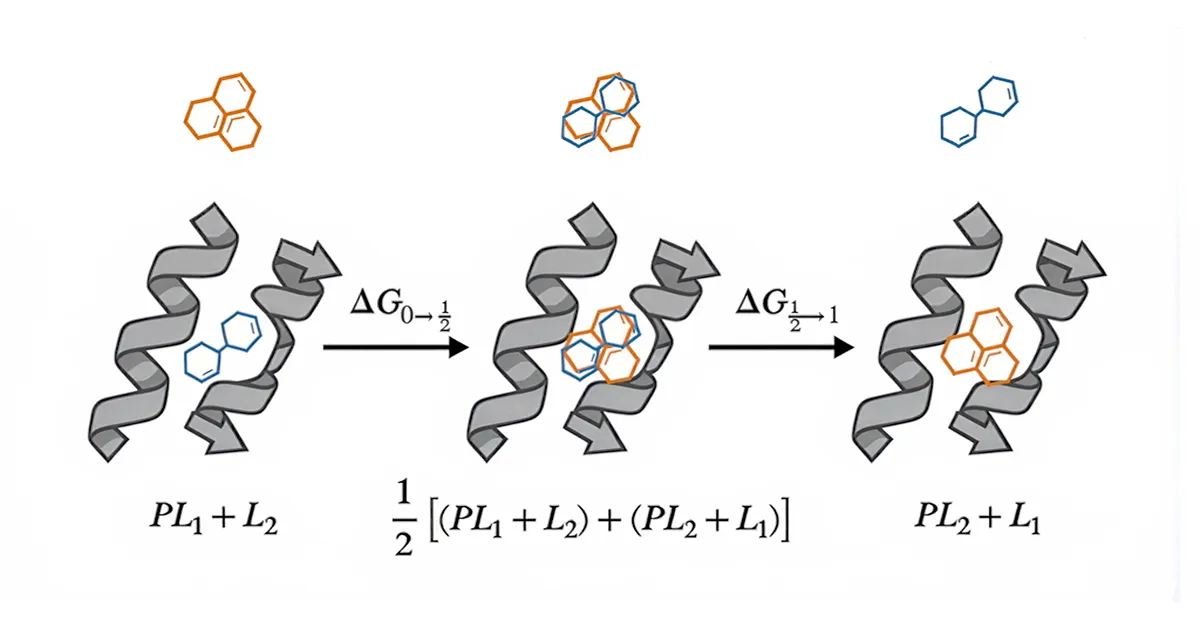
SandboxAQ researchers have developed a new method, Nonequilibrium Chimeric Switching (NEX), that delivers experiment-level accuracy in relative binding free energy (RBFE) calculations across chemically diverse compounds, including scaffold hops that usually break conventional pipelines. NEX achieves this without manual tuning, making it ready for autonomous, high-throughput drug discovery workflows.
The findings, released on ChemRxiv in April 2026, mark a meaningful step toward agentic molecular design where AI pipelines can prioritize compounds reliably at scale with minimal human intervention.
Predicting how tightly a drug candidate binds to its target is one of the most consequential calculations in modern drug discovery. Traditionally, R&D organizations have had to choose between:
Standard alchemical approaches also depend on favorable “overlap” between molecular states; when that overlap breaks down, during scaffold hops, charge changes, or ring-breaking transformations, predictions become unreliable and failure rates climb. The net result has been a persistent tradeoff between accuracy and chemical diversity.
NEX has found a new way to resolve this tradeoff.
NEX introduces a conceptually simple but mechanistically powerful idea using nonequilibrium statistical mechanics: instead of rapid switching directly between two physical ligands, it routes the calculation through a nonphysical “chimeric” intermediate that blends both ligands simultaneously.
This chimeric intermediate reshapes the alchemical pathway in ways that matter for both accuracy and robustness:
From an executive perspective, the important point is not the math; it’s that the pathway itself is engineered to be numerically stable across difficult transformations, so teams spend less time debugging edge cases and more time running campaigns.
The SandboxAQ team evaluated NEX across six well-characterized protein targets: BACE, CDK2, JNK1, p38, Thrombin, and TYK2 to test both accuracy and robustness. Most predictions landed within ±1 kcal/mol of experimental values, the benchmark threshold that separates reliable signal from noise in RBFE work.
The precision metrics underscore the stability gains in a comparison with equal compute time:
For scientific executives overseeing portfolios of programs rather than individual runs, our hope is this delivers:
Scaffold hopping, moving between structurally distinct chemical series, is where most RBFE workflows either demand intensive expert tuning, expensive compute, or break down entirely. It is also where many of the most strategically valuable hit-to-lead and lead expansion decisions are made.
NEX was tested on a challenging 45‑transformation BACE1 scaffold-hopping benchmark with no manual protocol customization:
Even under these constraints and no additional sampling time, the method achieved a Pearson correlation of r = 0.71 against experimental values, using the same sampling parameters applied to simpler lead optimization benchmarks.
We believe this demonstrates NEX performs reliably across diverse chemical transformations without expert‑in‑the‑loop intervention.
Under the hood, NEX operates within a dual-topology framework built on the Alchemical Transfer Method, preserving both ligand topologies throughout the simulation. Critically, NEX generates equilibrium endpoint ensembles as a byproduct of the production protocol. These trajectories capture:
Downstream analysis pipelines can reuse this data without additional simulation cost, enabling richer structure-based insights and future AI models that learn directly from physically meaningful trajectories.
The framework is also explicitly modular: enhanced sampling strategies and machine‑learned force fields can plug in without modifying the nonequilibrium estimator itself. In other words, NEX is not a standalone point tool, it is a foundation layer for increasingly automated molecular design systems.
We believe NEX lays the groundwork for fully autonomous, agentic molecular design, where stability and failure resistance are table stakes for making reliable decisions at scale.
To explore how NEX could support your pipeline — from hit-to-lead through late-stage optimization — fill out the form below.
For technical readers, review the full methodology and benchmarks at:
Pitman, Sood, Rufa, and Huntington. “Nonequilibrium Chimeric Switching (NEX) Stabilizes Binding Free Energy Calculations Across Chemical Space.” ChemRxiv, April 2026.
https://doi.org/10.26434/chemrxiv.15001585/v2

