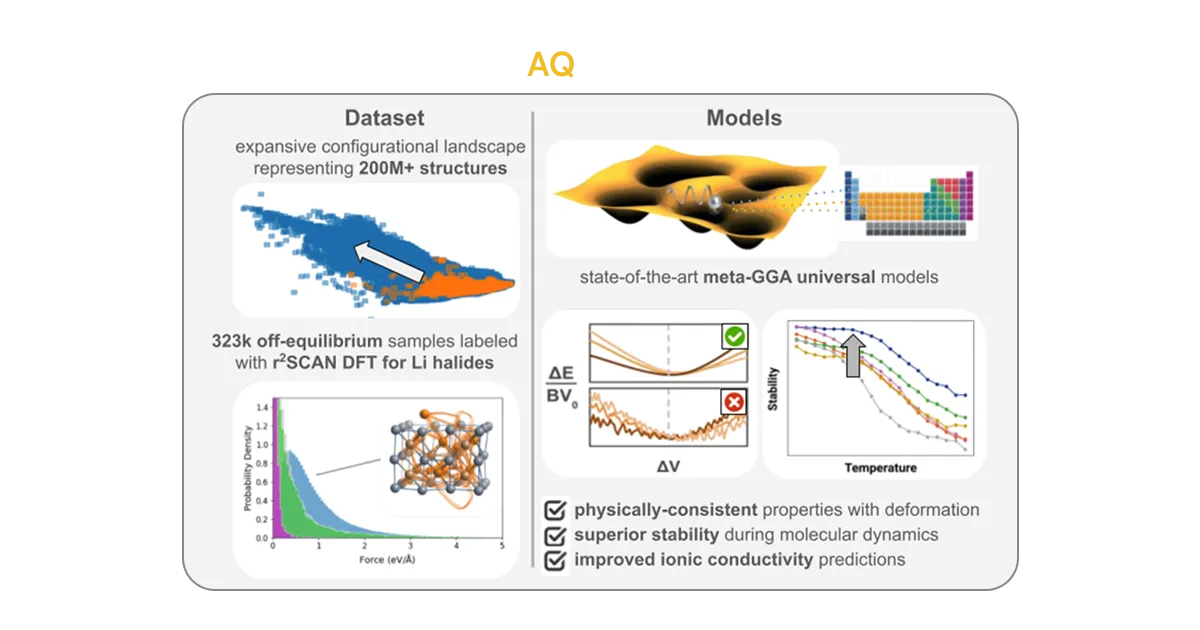
The AISim team at SandboxAQ is releasing AQVolt26, a specialized dataset and suite of machine-learning interatomic potentials (MLIPs) designed to accelerate the discovery of next-generation solid-state battery materials. Containing 322,656 high-fidelity Density Functional Theory (DFT) calculations of lithium halide electrolytes at the rigorous r2SCAN level of theory, AQVolt26 addresses a critical bottleneck in computational materials science: accurately modeling the complex, high-temperature dynamics required to simulate battery performance. Leveraging GCP and NVIDIA DGX H100 cloud hardware, we created AQVolt26 to help transition the industry from slow, iterative lab-based synthesis to rapid, AI-driven computation.
From Prediction to Discovery: SandboxAQ’s Battery AI Journey (2023–2026)
At SandboxAQ, we drive deep impact at scale through Large Quantitative Models (LQMs), AI models trained on rigorous scientific, rather than linguistic, data. AQVolt26 builds on a multi-year effort to transform battery and energy storage materials R&D through AI LQMs.
Following these milestones, AQVolt26 represents our next step: bringing LQMs into materials discovery for next-generation batteries, complementing our prior work in performance prediction and lifecycle modeling.
For the electric vehicle (EV), consumer electronics, defense, grid energy storage markets, the transition to All-Solid-State Batteries (ASSBs) promises higher energy densities and the elimination of flammable liquid electrolytes. Among the leading candidates for solid electrolytes are halides, which offer superior ionic mobility, wide electrochemical stability, and the mechanical deformability necessary to maintain robust interfacial contact within the battery.
Discovering and optimizing these materials requires massive computational screening to project the rate of ion movement. While traditional DFT calculations are prohibitively expensive for large-scale dynamic simulations, AI-driven machine-learned force fields can run these simulations thousands of times faster.
Recent foundational open-source datasets, such as MatPES, MP-ALOE, and the Materials Project, have driven massive progress in this field, enabling the creation of highly capable, universal foundation potentials with broad coverage of the periodic table. However, dynamically "soft" materials like halogenated solid-state electrolytes present a unique edge case. Their highly polarizable anions create shallow potential energy basins, meaning atoms undergo extreme distortion at the elevated temperatures (>1,000 K) required to computationally simulate ion transport.
Foundational potentials, while exceptional for general-purpose applications and stable chemistries, may experience a critical force-energy asymmetry when confronted with these highly specific, far-from-equilibrium states.
AQVolt26 does not replace foundational datasets; rather, it serves as a highly targeted complement to resolve this high-temperature blind spot. By specifically mapping the highly anharmonic, molten-sublattice configurational landscape of lithium halide materials, AQVolt26 allows universal models to maintain physical consistency under extreme conditions.
When co-trained with MatPES and MP-ALOE, our AQVolt26 models provide three critical advantages for battery development:
AQVolt26 extends SandboxAQ’s battery AI platform from prediction → simulation → discovery.
For battery manufacturers and automotive OEMs, AQVolt26 represents a significant reduction in computational cost and experimental risk. By co-training with AQVolt26 alongside near-equilibrium data, we have bridged the gap between strict 0 K ground-state precision and high-temperature dynamic robustness. This allows researchers to confidently run high-throughput screening for ionic conductivity on novel battery materials without sacrificing accuracy or stability.
Get Started with AQVolt26
You can access our pre-trained model checkpoints on Hugging Face.
For full methodology and benchmarking details, see our paper on arXiv.
If you are interested in using the AQVolt26 models or dataset for commercial applications, or would like to explore collaboration opportunities in battery materials discovery, please contact us at materials@sandboxaq.com.

